OUR OLDEST RESIDENT TALKS ABOUT HER LIFE
Enid Gray is Temple Street's oldest resident. She lives with her companion Derek van Eerde at 37 Temple Street, which still has a small hairdressing salon at the front of the house. Her mother-in-law had run the business until Enid took it over in the 1940s with her late husband Reginald. Enid has two daughters, seven grandchildren and six great-grandchildren. Here are a few of her memories, told in her own words.
‘I was born in Brighton on 10 October 1919, so I'll be 94 next birthday.... it was at our home in Loder Road going up to Five Ways, then we moved to Richmond Terrace in Richmond Place, opposite St Peter’s Church, one of those very tall houses.
‘My mother had a maid living in – everyone did in those days – and when I was around five we moved to Portsmouth because my father was a officer in the Royal Navy.
 |
| Enid taking an early bath at Loder Road |
 |
| Enid as a baby sitting in the garden at Loder Road |
‘We lived in Laburnum Grove which was nicknamed Brass Button Avenue, because that was where the officers lived, and he was a Chief Engine Room Officer. I think I only ever saw him once or twice because he was away at sea a lot...he just sort of dropped in now and again.
‘In 1926, his ship HMS Valerian went down in a hurricane just off Bermuda, and he was drowned...I just remember being palmed off with some relation and they gave me porridge, and I hated porridge!
 |
| HMS Valerian, a 1200 ton minesweeper, was stationed in the West Indies |
 |
| An artist's impression of HMS Valerian overwhelmed by a massive storm in 1926 |
'It was dreadful for my mother of course, and I do remember that it was a terrible time too for my grandmother who was living in the house opposite St Peter's Church. Her husband, who had been the Brighton and Hove Senior Manager of a Building Society in Ship Street, suddenly lost his job when it was discovered he'd gambled all the money away.
'Then he died, and my grandmother had to sell the house – it was very sad. My mother was a widow, and so it was two widows who went back to Portsmouth, and they started up a haberdashery shop together.
‘I first went to school in Portsmouth and when I was 12 we came back to Brighton and I was sent to Varndean, which was a private school in those days which you had to pay for. I wasn't clever enough for a scholarship, but as I had lost my father on active service, the Navy paid for my fees.
'I met Reg, my husband to be, at the Top Rank ice rink in Brighton when I fell over and he picked me up.
'He’d been at high school on the Isle of Man when his father died and he had to give up his studies. He moved to Brighton to live with his mother and grandmother.
'We were married in 1937 and lived first in Hollingbury Road, then we moved to 23 Temple Street, his family home – my mother-in-law, who was called Winnie Lane, had actually been born at Number 46.
'Temple Street was just as it is now, but without the cars. The people were very nice and there were more families than nowadays – they didn't have all these students. All single houses, much better.
'In the war we went back to Portsmouth to be near my mother who'd moved back there again.
 |
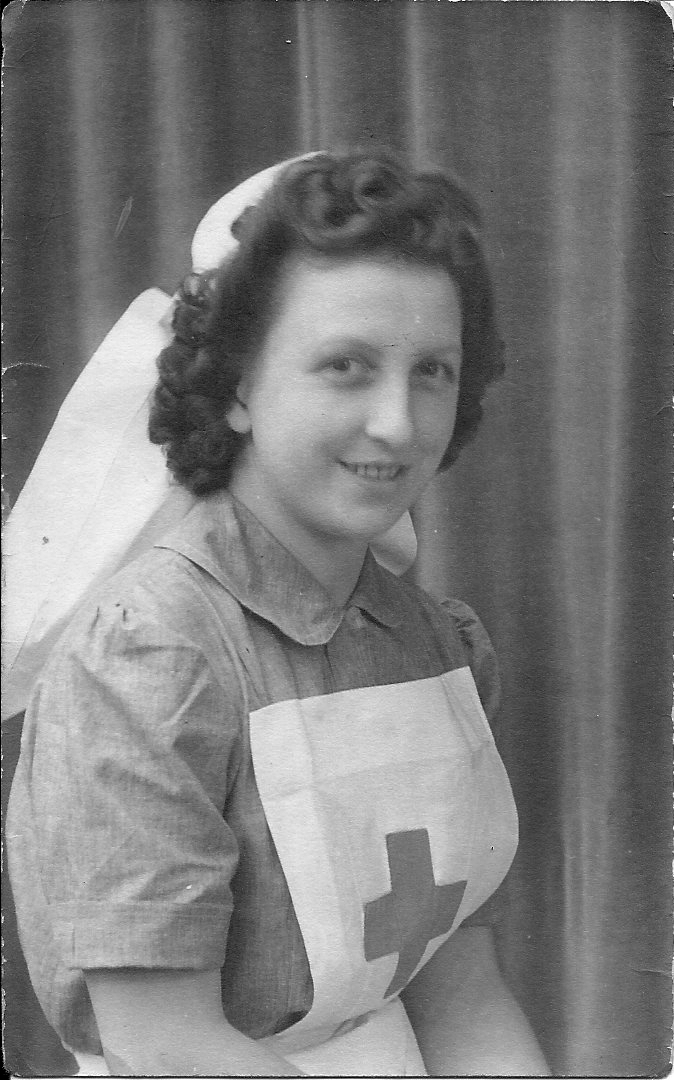
| 1944: Enid in her VAD uniform |
 |
| Enid's husband Reg (sixth from right, top) with a group of Chindits. The Chindits were a British Special Force that served in Burma and India in 1943-44 and were trained to operate deep behind Japanese lines |
‘I joined the VADs, which stood for the Voluntary Aid Detachment,
but that wasn't what the boys called us. They used to make up names like
Virgin After Destruction, or Virgin In Distress!
‘Reg went off to Burma as a Chindit, fighting under Colonel Wingate, and I became a nurse, though not a qualified medical one.
'I just used to look after the boys, put them on the bedpans, that sort of thing... washing their things...and give them enemas. That was awful. The first one I gave went wrong and it went all the over the bed...there were Queen Alexandra's Nurses in charge of us, and they were very strict. They were very cross.
‘Then there was one time when I was supposed to be giving a sleeping draft to a patient. He had been such a grumpy man that I woke him up to give it to him!
 |
| Enid worked as a nurse in the Second World War |
‘After the war we moved back into Temple Street. Reg’s uncle had a hairdressing academy in First Avenue, the place is still there, so Reg knew the hairdressing business, and he trained me.
‘We had two children, Lynne and Jane. There was no bathroom so they were bathed in the kitchen sink.
'There was a builders yard owned by Mr. Crump next door to us, and they worked on barrows. Every morning at 8 o’ clock we'd hear the barrows and we knew we had to get up.
'The lighting shop which has just shut, the one on the corner, used to be a car showroom. We were up at the other end of the Street – June Smythe who still lives in the street used to go to school with my eldest daughter Lynne. There used to be a saleroom next door but one to us – it was quite nice, I used to pop in and have a look – they've got quite a nice place in Hove now.
 |
| 1919 – Enid's future husband Reg driving a goat cart down Temple Street. Sister Rita riding shotgun |
'They were lots of fishermen's houses in this street before we lived here, that's what I've been told anyway. I have a picture of my husband as a boy, in a goat cart picture playing in the middle of the road – you couldn't do that now.
 |
| Reginald and Enid outside their hairdressers at 23 Temple Street |
'We had a hairdressers, and it's always been in our house - first at Number 23 with my mother-in-law and then in the house we're in now, Number 37. We bought it for £3,000.
‘We were always very busy – we never had a sign, we had a big glass plate and that was always in the window. I remember a new customer coming in and I asked if someone had recommended us, and she said 'no, but I always thought your house looked so clean and your curtains so nice.'
‘We never had to have any advertising and the business always flourished. The mayoress used to come up here every week to have her hair done. Our customers were such lovely people – if we didn't like anybody we wouldn't have them!
'We had three basins and six chairs – we worked very hard, and we always had an apprentice who would stay with us for three years. Many of the customers used to say 'no I don't really want him to do my hair' ...they were lovely boys, though, but they had to go after three years.
 |
| L-R: Mrs Sara Dampman, Enid's mother-in-law; Enid's daughter Jane, Reginald and Enid at a golf dinner in the 1960s |
'My eldest daughter recently had her hair done on the Western Road –
it cost £70, £100 in all – in our day we charged £2.00, which was quite a
lot of money then. But we did have a good life, we always had wonderful
holidays, used to drive over and take the children to France and
Germany.
'Once one of my customers said 'look at this' and handed me a brochure which said 'a trip on Concorde to Cairo for a week' and I said it was lovely but I couldn't afford that. She said, 'Oh no, I want to take you, I want to pay for you, I don't want you to spend a halfpenny...'
'I've still got one customer, who lives in Horsham, and comes down every fortnight, and I've been doing her hair for 60 years, and she's a year younger than me. She's forbidden me to die before her, because nobody can do her hair like I do!
 |
| Enid in her garden after moving over the road to 37 Temple Street |
 |
| Enid in her hairdressing salon at 37 Temple Street |
‘After I die the house is going to stay in the family. I didn't want it sold. My girls are soon going to turn my salon in the front into a bedroom, which I will use, and the back room into a new sitting room.
‘Derek, my ‘toyboy’ is 79, and we’ve known each other since 1990. How did we meet? He’ll tell you.’
 |
| Enid's companion Derek van Eerde, who first met her in 1990 |
‘I used to be in farming, ‘ Derek says, ‘we had a pick your own soft fruit enterprise – Enid came to pick some strawberries and I got chatting with her because I wanted to change my car that year, and I wanted a Honda or I thought I did at the time, and she came by in a little Honda Civic. We got chatting, and that's how it all started. She soon had me picking the fruit for her!’
 |
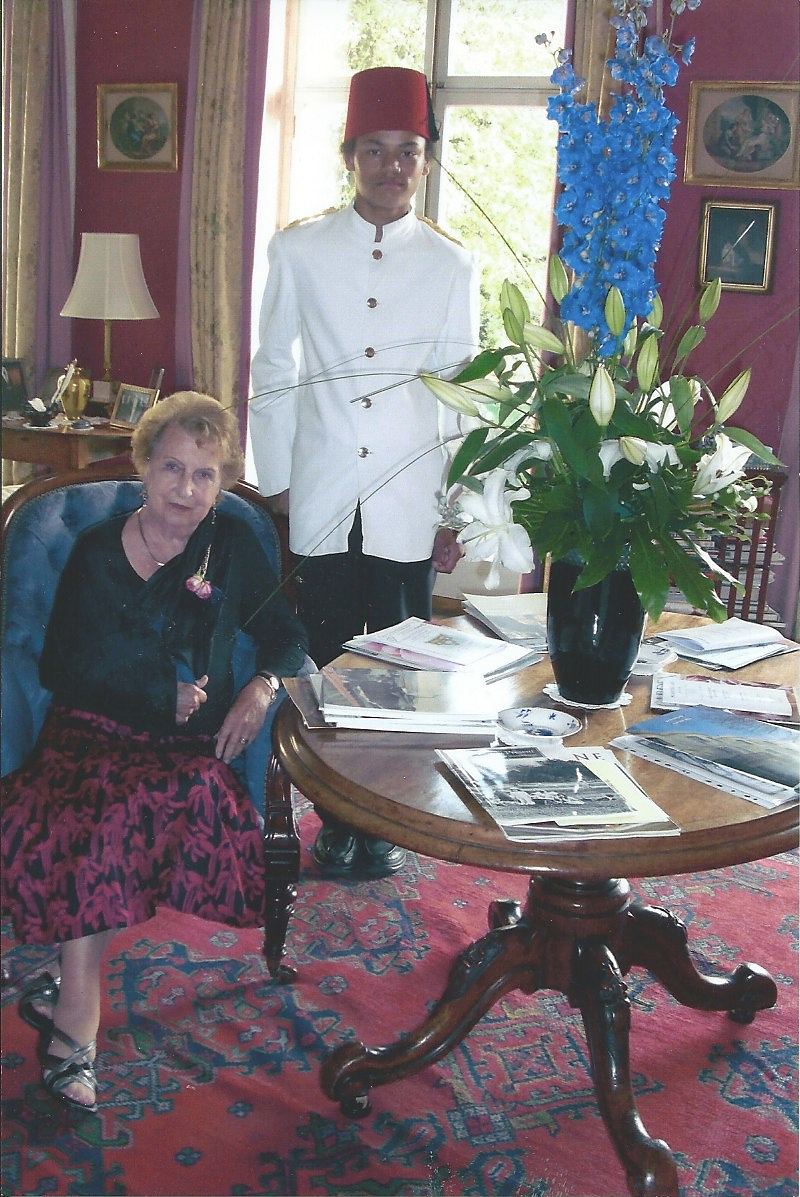
| Enid at Montpellier Hall, a fine late Regency villa in nearby Montpelier Terrace owned by her friend Roger Amerena |
‘I'm having such a lovely life,’ Enid says. ‘I went out yesterday to a pub for a meal for Derek's birthday, they were seven of us, all gay, except for Derek, and my son-in law – they were so good to me – they buy me things and they're so lovely. I've still got a lot of things to do.'
 |
| 14 March 2013. After Enid's unveiling of the new Temple Street sign, from left: Brighton and Hove Mayor, Bill Randall; Enid; Derek; Enid's daughter Jane |
|
|
|