Showing posts with label History. Show all posts

Tuesday, 25 August 2015

Elephants at the bottom of the Street

Thursday 13 July 1899 was a very special day in Brighton. 

Over excited children hadn't been able to sleep the night before and expectant adults lined the streets three deep. 

The circus was in town! 

There goes The Greatest Show On Earth

The lucky folk living in Temple Street could just stroll out of their houses and there it was, slowly going past the bottom of the road, making its lumbering, noisy, fantastic way along Western Road into town. 

This wasn't any old travelling amusement either – it was Barnum and Bailey's, the most famous circus in the world on its grand tour of Europe.

The American show was travelling around the country by railway that year and, as was the custom by then, on leaving its special train, it paraded through town to advertise that night's show. 

The crowds lapped it up. That year Barnum and Bailey's procession was three miles long and included a menagerie, exotic horsemen, dozens of elephants, clowns, acrobats, jugglers, an enthroned king and queen, a military band, 70 horses, untold sundry beasts and a collection of 'living human curiosities'. 

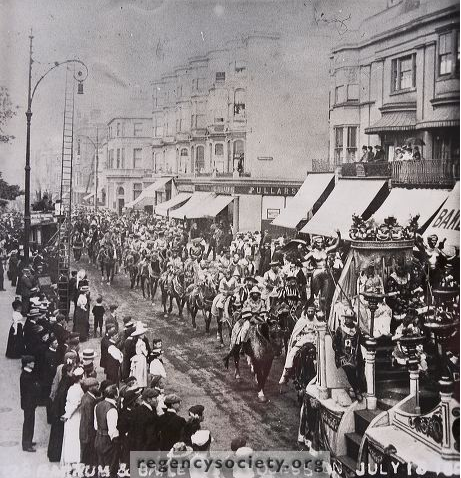
Here are two interesting old photos showing the southern end of Temple Street, looking west, as the procession rumbled by, and one shot taken from Bedford Square looking east.

   In the two photos featuring Temple Street there is no sign of Temple Bar on the corner, showing a shop called Pullars instead.


The third photo shows the less exotic back end of the parade. An omnibus is following on and many of the crowd are starting to walk behind it. You can see that all the houses on the north side of in Western Road, looking east, still have their gardens at this time, before they lost them in its gradual widening. The Council started to buy up houses on the north side in 1906 but it wasn't until 1935 that the final property came into line, all gardens were gone, and the widening could be completed.


Looks like it might have been a sunny July day judging by the parasol on the top of the omnibus


  Photographs thanks to the Regency Society and James Gray Collection

Friday, 31 July 2015

The value of a Temple Street house - in 1936

An old Auctioneer's note of Particulars from 1936


So houses in the street were fetching around £750 in those days. That, by one method of reckoning here, is the equivalent of £47,596 in 2015 allowing for inflation – which is less than a tenth of the going price now (in some cases, much less).

It was leased from The Portsmouth and Brighton United Breweries who owned a number of Brighton pubs at this time.

Wednesday, 1 July 2015

Of goats and kids

One of the most popular images on our website – judging from the number of times we’ve seen it copied –  is that of young Reg Grey driving a goat cart down the street in 1919. Reg later owned a hairdresser’s at Number 23 and his wife Enid Grey still lives in the street over the road at Number 37.

Reg’s mum or dad, or perhaps an indulgent uncle, would most likely have hired the cart nearby on the seafront next to Hove Lawns. Goat carts had been a popular attraction in Brighton since the 1830s, according to the Francis Frith website, but they were expensive, costing one shilling per hour by the mid 19th century.
Reg and his little sister Rita driving their goat cart down Temple Street

A flower girl and goat carts for hire near Hove Lawns, c.1890

A goat should only pull about 1 ½ times its own weight, according to experts in the field, so the little carts were perfect for carrying young'uns up and down the front, but they were also used for more workaday duties by tradesmen of the time, delivering items such as milk, vegetables and barrels of water.

Many of the carts, few of which have survived, were beautifully made by craftsmen and two motor companies of later renown, Peugeot in France and Studebaker in America, manufactured them before moving on to more glamorous vehicles.

Sadly the goats were often abused and ill treated. Local councils at seaside resorts later licensed all operators giving goat carriage rides and conditions improved somewhat.

In Brighton, the last known Harness Goat Licence was issued in 1953.


A couple of Victorian children take 'Our Morning Ride' on Madeira Drive


Saturday, 14 March 2015

The Very Old Postbox in the Wall

Pre 1890: the interesting postbox set in a wall


There's an unusual  postbox around the corner, set in the wall of Montpelier Terrace, in which many Temple Street residents still post their letters. All we knew about it was that it was Victorian, and looked interesting. Roger Amerena of the Brighton and Hove Heritage Commission, was consulted. He is not only a fount of knowledge about our area, but lives just feet away from the box in Montpellier Hall.

Mr Amerena has provided just what we needed. He writes

'The two identical Montpelier Terrace and Temple Gardens wall letter boxes are from the 1887 series known as "the Jubilee Boxes".

W.T.Allen and Co of London were awarded the contract to make them in 1886 and that company continued to produce these same styles for another 75 years.

Allen's produced three sizes which were in production for this period. Type A, the largest; Type B WB/85 (formerly No 1) which are in situ in Montpelier Terrace and Temple Gardens; and Type C (No 2).

Type B is fairly common nationally but still important in postal history. In Brighton it was rare. The style was installed in Brighton prior to Hove Corporation being established in the 1890's. Thus there are not known any to be placed in Hove.
    
I understand the Montpelier box was installed for Alderman Sir Joseph Ewart JP MD, who was Mayor of Brighton three times from 1891 to 1894.
Alderman Sir Joseph was ex Irish Militia and Deputy Surgeon General of the Bengal Army, and been in service during the Indian Mutiny. He later became Surgeon General of the Indian Army, and after contracting typhoid, retired to Brighton in 1879 to live in Montpellier Hall. 
For mayoral duties this box would have been important to him – in those days you could post a letter in the morning and get a reply in the afternoon. The Brighton telephone service had not quite arrived.'


Saturday, 24 May 2014

Back to the 1920s on the corner

The shop signage from the Caffyns' showroom of the 1920s
The extensive refurbishment of the corner shop at 123-4 Western Road has revealed the original signage from the days when it was a car showroom for Caffyns. It opened in 1920.

After Classical Lighting – eventually! – closed, the shop briefly served as a vintage second-hand outlet for the Martlets charity, and is now being completely fitted out as an ice cream parlour.

Here's hoping that the original signage, with its classy embossed gold lettering set behind glass, can somehow be incorporated into the new scheme.

Saturday, 19 April 2014

1950s-60s: the ladies of Temple Street

June Holloway has lived in Temple Street since the early 1950s. Here she looks back at some of the memorable characters who were her neighbours in those days

June Holloway in the 1980s
The thing that I most remember is the women. Back in the 1950s the street always used to full of older women, and when I looked into it later as I did a bit of local research, I discovered that quite a lot of the houses were owned by women and I realised, thinking about it afterwards, that these women fell into a number of groups.

There were the ones who had never had a husband because of the First World War, and those who'd had a husband who'd died in the War, and those who's husbands had just gone, for one reason or another. There seemed to be an enormous quantities of very strong women coping on their own, and even amongst those who had husbands, it was these women who seemed to be the ones who were assertive.

They were real characters, wonderful people – these are just a few…

Cissie Crook, for example, who died only about 10 years ago at 98 – she lived from 1932 at number 8 and was the wife of Soloman Crook, who was one of the tailors who had lived in the street. She was a very tiny lady, but nobody argued with her! Cissie had that way of talking to people which was bantering, but sounded very fierce until you got to know that she always had a sweet in her pocket for a small child.

In her later years she took a taxi down to the casino in the afternoons. She was almost completely deaf by that stage, and she used to say 'I can't do anything else these days - but I can go down there, I take £20 and then I lose it, but they're very nice to me, give me a little glass of something...'


Cissie Crook (centre) with Enid Gray and her daughters, Jane
Miss Coop lived at number 42. Did you ever see Giles cartoons? Well, she was just like Auntie Vera – Auntie Vera had a great long black coat down to the ground, a black felt hat and a perpetual drip on the end of her nose, and Miss Coop was a bit like that. She must have been in her 80s and she lived alone. She'd always come out in the morning with her shopping basket and go off to do her bits of shopping; she was like a little bird. When she died in her house they went in and they found piles and piles of wet newspapers, from all the damp coming up through the floorboards.
Auntie Vera
 At number 41 was Mrs Hughes, a Welsh lady, she was straight out of Dylan Thomas in her apron or overall with sleeves rolled up to reveal burly forearms. She would always be outside with her broom, because that's where the gossip was to be had, with anyone who walked past.

Besides, every proper housewife washed their doorstep before 10 each morning in those days. She once killed a rat with that broom.

Mrs Hughes had a faded ex-Indian army widow friend who lived nearby. They would always go out together. A lot of people around that time, in the 1950s, used to have a lodger, letting out one room here or there to help pay the bills.

Hyacinth Morton, at number 31, was the stepdaughter of Sir Ronald Storrs, who had been Governor of Jerusalem in the days of Laurence of Arabia, so she was brought up as the daughter of a very wealthy house, and she had the most amazing upper class accent.

Hyacinth had met everybody - she was a winner at a dinner party, coming out with things like "Yes, well I met King Farouk, he was dreadful man. When I was introduced to him he said, "Take this women away - I can't abide ugly women!" – and 'I remember George Bernard Shaw really well. I sat on his knee when I was 12." And she was at one of the Nuremberg Rallies and was on the platform 20 feet away from Hitler. 'He was so charismatic,' she said, 'I had to hold onto my hands so I didn't shout "Sieg Heil" as well!'

She was wonderful. I once met her on the street - this was by the time Peter and I were married, and she said 'Ah! Send the dear boy over this evening, will you - I've got a light bulb that needs changing. You'll come over and have a little gin with me whilst he's doing it.' I said 'Right, okay - about six?' and she said 'I'll get out my diary...'

Sir Ronald Storrs, Governor of Jerusalem
One rather strange lady had a penchant for scratching doors and cars with her keys. She was a simple soul, who'd had a horrible accident, been injured and received a sum in compensation. A taxi driver had become her "best friend", and used to take her to places – and systematically robbed her of the entire £20,000 she'd received, which was a lot of money at the time.

Mrs Shepherd, the ever-cheerful Irish lady at 27a, was married to a merchant seaman who came back home every two or three years. They had two children together and in 1958 their son was getting married, and wanted some money for the wedding, so he offered to paint the outside of our house – and that was the first time it was done. The price was £18, my mother was very happy with that – and so was he, it paid for the honeymoon.

Mrs Agomber was a very sad widow, she was a lodger in number 28, on the top floor. She'd lost her husband in the First World War, and must have been in her 80s when we arrived in the Street in 1953. We used to go and buy pink paraffin for her at Mence Smith, the ironmongers on the corner of Montpelier Road, where the Mad Hatter is now. She used it in her old oil heater that was her only source of heat. It must have been horrifically dangerous.

She became ill, and she was beside herself with fear; 'They'll take me to the workhouse, they'll take me to the workhouse – I'll die on the hill,' she said. This is the building that is now Brighton General Hospital at the top of Elm Grove, which in living memory did indeed used to be the Workhouse.

And sure enough, when she became ill, they took her there and she was terrified, and she died there.

Of course these are just a few – there were many others, great characters and good neighbours over the years, who have all been a part of what has made this street such a splendid and interesting place to live.

June and Peter

Sunday, 16 March 2014

A very short cut to the pub


Number 12 used to have a very useful facility – direct access to the Borough Tavern that was at number 39 Borough Street. The back of the pub was just on the other side of the wall, and there was a doorway between the two properties.

The passage from the pub emerges in Temple Street, giving thirsty punters a very handy short cut.

Ian Burridge, who now owns number 12, told me he had come across a blocked off doorway when he was renovating a room at the back of his property, in the position that can be seen on the Ordnance Survey below.

This seems to explain the glass ball hanging outside the house in the recently discovered photograph, detail below, on which the word 'Spirits' can be seen. Spirits and more were to be enjoyed only a few steps away.

Temple Street on an Ordnance Survey map of the 1890s

 The passageway to the pub (marked P.H.) through Number 11 Temple Street
The glass ball advertising 'Wines, To Order, Spirits' above the passageway to the pub in Borough Street


Friday, 14 February 2014

'The street was a lot grimmer in those days'

June Holloway has lived here since she was a child – and she's told us of what life was like in Temple Street in the 1950s. Here's the first part

June moved into the Street in 1954
We arrived in 1954, and my mother having bought this house, no. 20, for £2500. We got a £500 mortgage and my grandmother said at the time 'you'll never get your money back on that'.

The street was a lot grimmer in those days, the houses weren't painted, they were all the colour of cement. It was only 10 years after the war, and there was paint peeling around the windows, and a lot of brown, dark green, and black, no colour in the street at all. There weren't any flowers outside or anything like that, and we still had the Victorian lamp posts which had been converted from gas.

The lamp posts had a bar sticking up at the side, and when you got to a certain size as a child, you were tall enough to climb onto it, reach up swing on the bar. That was a sort of rite of passage. Actually there were few children in the street then, just as there still are, it's never been a family type of street, and those that were there didn't play out.

Thomas Kemp, who owned the land, sold my plot to a sea captain, no 20,  and he lived in the house until he died – I think he got a loan from Thomas Kemp in order to build it.

A MIX OF BUSINESSES IN THE ROAD


The three Gothic-style  houses at 3,4 and 5 were for the Reverend Gentleman who ran the school which was over in Borough Street, and they also housed the lady who ran the girls' school, and I think No. 5 was a school for the girls, where they could learn to be domestic servants. Renee Shulman, who used to live at number 2, did quite a lot of research on it.

No 1 was in use as a shop – 25-30 years ago it was a hairdresser's. Karen the hairdresser told me at the time that there was a cellar underneath with a floor with gulleys in it and  big hooks in the ceiling – they thought it was probably a butcher's shop and they would have hung the meat there. It was a turf accountant in 1967, and then a hairdresser again - there were all sorts of little businesses coming and going in the street.

There were two Jewish tailors – Mr Altman, who worked from home at no. 7, and Mr Crook (next door at no 8) who had a business down in Bedford Square - there was a quite a large Jewish community in Hove and the area around in the early years after the War. Cissie Crook was a great character and we'll come to her later.

No. 41 is a private house now, but was previously part of Inmans, the auctioneers, and before that, an engineering works called Hamiltons – they had a crane and used to take engines in for repair.

When we moved in back in '54 the corner shop opposite the Temple Bar (formerly Classic Lighting and now the Martlets Charity Shop) used to sell fireplaces - 'fyreplaces' as they called them. They went broke and a shop selling tiles moved in – that would be in the 70s.

There was an auctioneer's in the street for a long time and they only moved out in 2005. They were called Perry's when I was little, and they sold on to Inmans. They owned no. 35, and they took over Hamilton's the engineering works at 41, so there was an Upper Inmans and a Lower Inmans. They had some very good bargains and we bought a couple of very good pieces of art there, that went for a song. I always used to leave a bid there, rather than bid in person – never brave enough to bid in person I knew I had no self-restraint!

Sale days were busy and exciting. In those days Brighton was a great antique centre, and there were some very dubious characters. They gathered out in the street before and after to fix prices among themselves. I think it was called a Ring, and it was illegal – very Graham Greene!

THE SHOPS AT THE TOP OF TEMPLE STREET 


At the top of the road on Montpelier Place there was a complete parade of shops – an electricians on the top corner, next to that a greengrocers, then a newsagent, next to that there was a junk shop, then there was The Montpelier pub, which is still there now.

Across from that on the Borough Street corner there was a sweetshop, which also had a little library, next door to that was a delicatessan, then there was a little gap, then on the corner of Norfolk Road there was a dairy, where there's a little grocery shop and off-licence now.

On the other side was a boot repairers and a butcher's, so you could just go up there and do your shopping, except my Grandma would always insist on going to International Stores and Sainsbury's on Western Road, and have a cup of coffee in Lyon's while we were there.

Western Road in the 1960s

In those days, Western Road was still quite Victorian in its way. The Sainsburys was a corridor-style shop, with marble slab counters on both sides, and you queued up for each item. They gave you a little docket, and you went up to a lady in a paybooth at the end. The butter was a big slab, and they chopped bits off, then they did mysterious things with two wooden patters to make it into a square, and wrapped it in greaseproof paper.

You waited in a series of queues, different ones for the bacon, another queue for the butter...it was still the wartime mentality and people expected to queue up.

It was just the women who shopped - I used to go out with my grandmother when I was about seven to do her shopping,  because there was no fridge, just a larder which was outside on the roof, and a meatsafe with a perforated thing on the side. You'd go out every day with your string bag – it was only the women you'd see out, the men were all at work, and the women were doing their marketing.

My grandmother never went out without a coat and a hat on, you were respectable when you went out shopping, none of this casual stuff. It was all still very formal, and you addressed your neighbour as 'Mrs So-and-So'– you could live next door to her for 30 years and still call her 'Mrs So-and-So.'

When my mother died in 1976 she was still calling other people in the street 'Mrs So-and-So'. I suppose it was in the late 70s and early 80s it loosened up...

MORE TO COME...


Friday, 3 January 2014

When we weren't even named Temple...

Back in the early days of the development of the Street, it wasn't known as Temple Street at all – a map from 1830, just as the street was first being developed, shows it called Bedford Square Road, which was cut in half by Western Road and carried on south to Bedford Square itself.
Early days, and just a small clutch of houses have been built on the East Side of what was to become Temple Street

Thursday, 29 August 2013

Sir Donald Sinden and Temple Street

Not many people know about Temple Street’s connection with that suave star of stage and screen, the late Sir Donald Sinden. Sir Donald* had a letter from 1886 which was addressed to his great-grandmother at 40 Temple Street.
Sir Donald Sinden –  a distinguished thespian with many Brighton connections
Sarah Sinden (nee Fogg) was born in Hull in 1842. She married Alfred Sinden and died in Brighton in 1934. Alfred died in 1881 and by 1886 Sarah had nine children aged between 8 and 20.
Sarah's oldest son, also Alfred Edward (Alfie), was born in 1871 and became the grandfather of the actor Sir Donald Sinden.
The letter was written by John Fogg to his daughter, Sarah Sinden, in 1886 when she was living at 40 Temple Street, which was described as a lodging house.
Alfred Sinden and Sarah Sinden (neƩ Hogg) c1870

‘Someone will wish they had written oftener…’


Here’s an intriguing extract from the letter.

"Wish Mother could write, she would if she could – she is now trying to sweep up the house poor dear soul. You must write to Emily. She will be glad to get a few lines from any or all of you. We often wonder you don't write to her. As for me, a poor old man, it does not matter so much - when I am gone somebody will wish they had written oftener."

See the whole letter at the Letters in the Attic project

* according to Wikipedia, Sir Donald – 9 October 1923 – 12 September 2014 – made his first stage appearance at the Brighton Little Theatre (of which he later became President) in January 1941, playing Dudley in George and Margaret in place of his cousin, Frank, who had been called up to war and so was unable to appear. In the 1940s in Hove, he befriended LordAlfred Douglas (known as Bosie), who had been Oscar Wilde's lover. On 23 March 1945, he was one of only two people who attended his funeral.

Temple Street in the 1950s


Reg and Maud Jinks moved into 3 Temple Street in 1961 – but before that the Walden family lived there. Sisters Terry and Bonnie Walden recall what it was like to live in Temple Street in those days

Girls of the house: Terry and Bonnie Walden
The Walden family arrived at 3 Temple Street in 1949. There were open fires in all the rooms and lincrusta wallpaper in the hall, which the girls liked to ‘pop’ (like bubblewrap today). All the front doors had canvas curtains to protect them from the sun in summer. Sisters, Terry and Bonnie have vivid memories of living in the street. Their mother bred budgerigars in an aviary in the backyard and also took in lodgers: two men came from the Isle of Wight to work as bus drivers and so loved Brighton that when they returned home, she sent them The Argus every week!

One door down a woman bred Persian cats. One door up the husband or brother had a dental repair workshop.

There was a tailor (Morris and Altman at no 7) half way up with two daughters. And further up a woman selling terracotta pots (Provence Pots no 21). John Adams at no 41 worked on the Brighton Belle and his was the first family in the street to get a television. The sisters watched the Coronation in 1953 and The QuatermassExperiment on it: television was an event and curtains were drawn and lemonade and sandwiches served. Ken Witty, a lifeguard on Brighton beach, lived near the top on the left. Half way up on the right was some sort of engineering workshop with men wearing green dungarees (Associate Engineering Ltd, selling motor car components).

Entertainment? The girls played all the usual children’s games out on the street. Of course, the beach was very close by. You could catch a paddle steamer to the Isle of Wight from the West Pier and go for boat trips in the fishing boats which pulled up onto the beach. And there were swings in St Ann’s Wells Park. Ice cream could be bought in a jug from Fortes next to the Metropole. There was a wonderful toy shop in Preston Street. Terry and Bonnie had bicycles and went skating at the ice rink in West St. It was a huge event when Father Christmas came to Plummer Roddis (opposite Waitrose which was then the Curzon Cinema) and when Princess Elizabeth visited the seafront in 1952.

Like Enid Gray’s daughter Lynne the girls went to Clifton College in Clifton Road. The uniform was green with yellow braiding and plaid skirts. Mrs Stanley was the head. There was a big old stove like an Aga on which cocoa would be made in the little bottles of milk, stood on it to heat up. Then you took your 11+ in St Mary Magdalen’s school hall. The walk to school took them past a sweetshop at the top of Victoria St where they initially used ration books to buy penny chews and sherbet dabs. The Post office was diagonally opposite and next to it a grocers which delivered every week.

Thanks to the CMPCA

Tuesday, 30 July 2013

Cissie at Number 8

Aidan Lunn
‘I still recall the first conversation with our next door neighbour Cissie, at No 8. As she was stone deaf the dialogue was pretty one way, but when you reach the age of 95 some decline in faculties is inevitable. She told us that she had moved into the house on her marriage, sometime before the last war, and that she and her husband had run a tailor’s shop on Western Road.

'Although now widowed, we were pleased to see that she was still able to get out, courtesy of the car that picked her up early
most evenings. Sadly, a year or so later she did have to move on to the local Jewish old people’s home, but we were somehow pleased when a couple of days after her departure the driver knocked on our door to check that the old lady next door no longer required her lift to the Casino in Preston Street. We had clearly come to a street with both history and character . . .'

Aiden Lunn, Number 7
Thanks to CMPCA

Friday, 21 June 2013

Rare old Temple Street photograph comes to light

The Warren Farm School prepare in Temple Street to lead a troop of Brighton Cadets c1910-13

Most of us have only ever seen one vintage Temple Street photograph – the one taken from the Western Road looking up the road on a very sunny day sometime in the 1920s. See below. But another one has just surfaced, recently bought on Ebay, and showing the street in a slightly earlier era.

The guess at this stage is that the photograph was taken around 1910. The boys in front of the parade are from the Warren Farm School.

This was an industrial school located in Rottingdean, its aim to give pauper children a basic education and a grounding in industry so that they could go out and earn a living. It opened in 1862, at the time when people began to feel that children should not be brought up in the workhouse.

Boys were taught trades such as gardening, tailoring and shoemaking whilst girls were trained in domestic service.  Many of the boys were also taught to play an instrument, often leading to a career in an army band.

By the by, the school was notable for its well: it was the deepest hand-dug well in the world, which took 4 years to reach water in March 1862, at a depth of 1285 feet.

There is a caption on the photograph: some words are difficult to make out, but most are decipherable: 'Imperial Service Cadets inspected by Col. Sefly (?)   Leaving headquayers (sic) headed by Warren Farm School Band.'

As for the houses in the background, the photo shows the west side of the street from Number 12 upwards. Number 11, just out of sight on the far left, seems to be a cycle shop. 

Number 12, which now has a boxed bay window, was sporting a balcony in those days, and was fronted by a bow window, on the ground floor at least. The Fire Point sign from that time is still there. 

Any further information or thoughts on the photo would be most welcome!

The fascinating Temple Street photograph taken in the 1920s